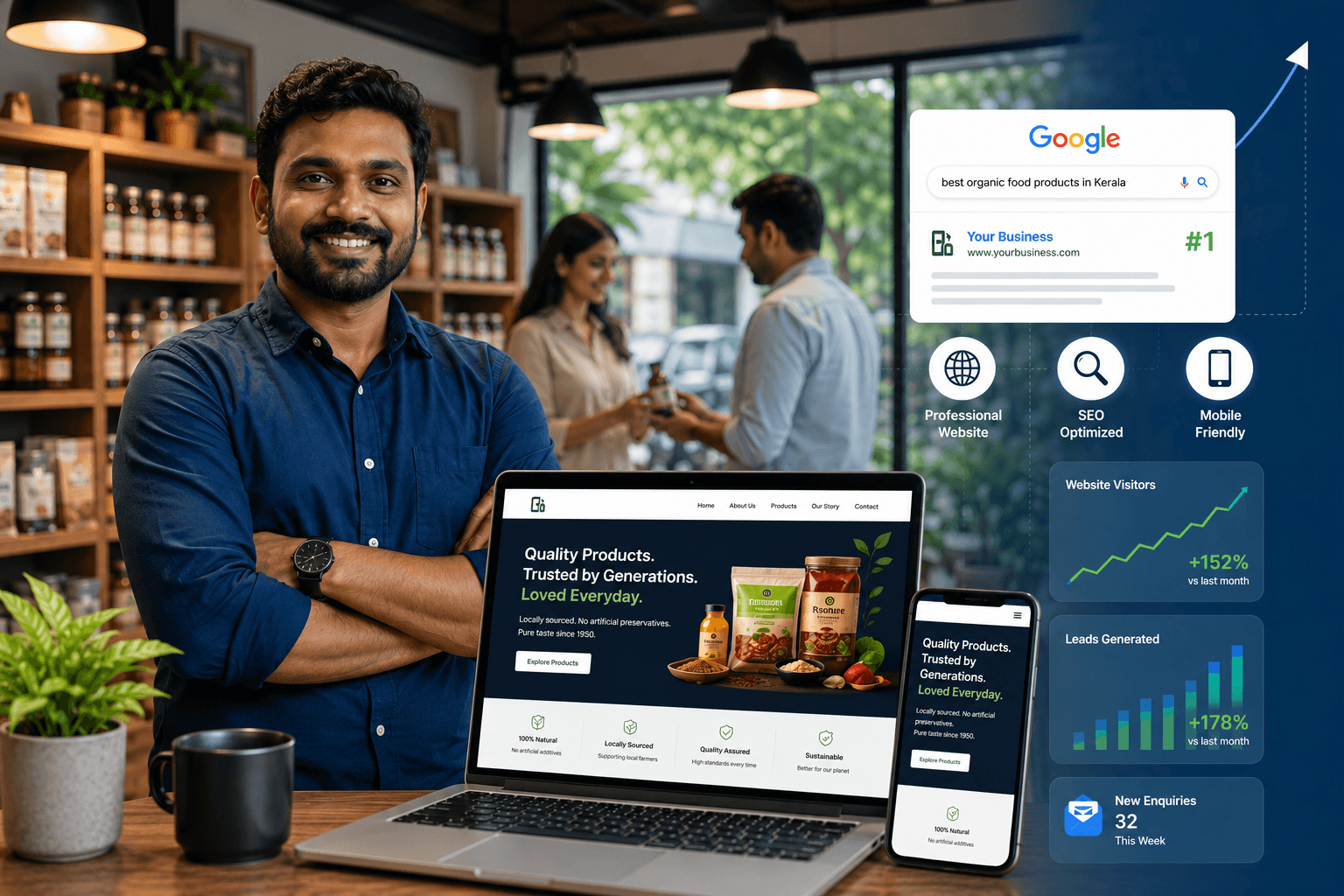
Why Do I Need a Professional Website for My Small Business?
Because your business exists in two places now — the real world and the internet. And in the internet version, your website is your shop, your salesperson, and your first impression, all at once. If that's missing or broken, you're losing customers you never even knew came looking.
"I Have an Instagram Page. Isn't That Enough ?"
This is one of the most common things I hear from small business owners, and I completely understand why. Setting up an Instagram page is free, takes twenty minutes, and you can post photos right away. It gives you an illusion that your online presence is strong enough for competition.
But the truth is, when you are on Instagram, you are restricted by their rules. If you need to push your products to your target audience, you have to keep up with the ever-changing algorithms of Instagram. If you do not play by their rules, your business goals can't be achieved. Your instagram will go unnoticed for sure. It won't stand apart from your competitors’ page..Your page looks like everyone else's page. You can't control how it appears, you can't rank on Google from it, and if Instagram decides to change its algorithm tomorrow — which it does, regularly — your reach drops overnight without warning.
A website is something you own. It shows up on Google when someone searches for what you do. It works at 3 AM when your team isn't available. It answers questions, builds trust, and gives people a reason to call or buy — without you doing anything in the moment.
Social media is important. But it works best as a way to bring people to your website, not as a substitute for it.
What does a "Professional" Website Actually Mean
People have a misconception that a ‘professional website’ automatically means that it is all about investing a lot of money or having animations on every single page. This is completely not true and I’ll tell you why.
A professional website means:
It loads fast. Slow sites lose visitors. Most people will leave a page if it takes more than 3 seconds to load on their phone — and almost everyone is on their phone. More than 60% of website traffic happens via mobile devices. A site that is perfect when viewed on a laptop but fails when viewed on a smartphone will be considered ineffective for most of your clients. Clearly. The visitor must understand within the first five seconds of landing on your site what kind of business it is, whom it is intended for, and what they have tto do next. You have to guide them in the right direction through your well-developed website. If not, the person will be too lazy to look for the answer. You can find it in Google mostly. There's a saying that : ‘A beautiful website with no SEO (search engine optimization) is like a well-stocked shop on a street no one walks down’. The structure, the content, the speed, the technical setup — all of it needs to be right for Google to show your business when someone searches for what you offer. It looks like you take your business seriously. People make trust decisions quickly. A bad website tells them your business either doesn't care about details or isn't well-established. A good one says the opposite.
The Real Cost of Not Having One
Let me tell you what's actually happening when a small business skips the professional website Someone hears about your business or sees your name somewhere. They pull out their phone and search for you. Either they find nothing, or they find a website that looks like it was built in 2012 on a free builder, with pixelated images and a phone number that goes nowhere. They move on. They find your competitor, who has a clean, fast, well-structured website. They call them.
You never knew that person came looking. You'll never know what you lost. This plays out hundreds of times over the life of a business. The cumulative cost of missing those moments is enormous — and invisible, which makes it even more dangerous. You're not seeing the loss, so it never creates urgency to fix it.
Different Businesses, Different Needs — But the Same Rule
One thing I've noticed across the projects we work on is that the need for a proper website cuts across every type of business. It's not just for tech companies or large brands. Let me give you some real examples.
G Factree is an architecture firm in Kochi — a collective of Kerala's leading design minds, as they put it. The challenge for them wasn't finding clients who knew their work. It was showing up for people who were searching for architecture and interior design services in Kochi but didn't know G Factree existed yet. We built them a clean, visually strong website that matched the quality of their actual work, and implemented local SEO so they started ranking in the right searches for the Kochi market. The website became a tool that found new clients for them, not just a page that existing clients visited.
Unitaste is a food brand with a history going back to 1950. They make quality products, locally sourced, no artificial preservatives. Real heritage. But their digital presence wasn't reflecting any of that. The challenge was taking a long-standing brand and presenting it in a way that felt modern and trustworthy to today's buyers, while communicating the sustainability values that set them apart. A website that does justice to a brand like that isn't just a page with a logo on it — it's a carefully structured platform where every section earns trust and every product page tells a story.
Synnefo Solutions is a course-providing institute. For an education business, the website is practically everything — it's where students decide whether to enroll, where they evaluate the programs, and where they take the first step toward registering. We built them a structured platform using modern technology with a backend they could manage themselves, organized course pages clearly, and made sure the whole thing was optimized for search visibility in a competitive education market. Their website went from being an afterthought to being the primary engine of student acquisition.
Three completely different businesses. A design firm. A food brand. An education institute. All of them needed a professional website for different reasons, and all of them got measurably different outcomes because of it.
What Happens When It's Done Right
Here's the practical picture of what a well-built website does for a small business: It generates enquiries without you being involved. Someone finds your site on Google at 11 PM. They read about what you do. They fill out a contact form or click your WhatsApp link. You wake up to a lead. That didn't cost you anything beyond the initial investment in the website and SEO.
It shortens your sales cycle. When a potential customer already understands what you do, has seen examples of your work, and trusts your brand before they speak to you — the first conversation is very different. You're not starting from zero. You're closing.
It builds credibility with people who don't know you yet. For existing customers, reputation is everything. But for someone discovering your business for the first time, your website is the entire basis for their first impression. A professional one says you're serious, established, and worth trusting.
It works 24/7 without requiring your attention. Your team goes home. Your website doesn't.
Why Sygmetiv — What Makes the Difference
There are plenty of places that will build you a website. Here's what's actually different about the way we approach it. We think about the business first, not the design. Before we open a design tool, we're asking: what does this business need the website to do? Generate leads? Sell products? Build brand awareness? Attract students? Rank for local searches? The answer to that question changes everything about how the website is built. A website for a marine equipment company in the Gulf has a different job than one for a catering service in Kochi, even if both look "professional."
Design and development in one team. A common problem is when design is done by one agency and development by another. The design doesn't account for how it'll actually work. The developer makes compromises the designer didn't intend. Things break between handoffs. At Sygmetiv, design and development happen together, with the same goals in mind.
SEO is built in from the start, not bolted on after. This is a big one. Many websites are built first and then someone tries to "add SEO later." That's like building a house and then trying to add the foundation. The way a website is structured, how pages are named, how fast it loads, how images are tagged, how content is written — all of this needs to be decided during development, not after it.
We've done this across industries and geographies. Our work spans architecture firms, food brands, education institutes, marine businesses, eCommerce stores, catering services, ERP platforms, and more — across Kerala, the UAE, Saudi Arabia, and Kuwait. That variety means we're not applying a single template to every project. We're drawing from real experience across different markets and different buyer behaviors.
We stay involved after launch. A website isn't a finished product the day it goes live. Content needs updating. SEO needs ongoing attention. Sometimes a page isn't converting and needs rethinking. We build for the long term, not just the delivery date.
The Bottom Line
A professional website for a small business isn't a luxury or something you do when you "get big enough." It's one of the foundational investments that makes getting bigger possible in the first place.
Your competitors have one. Your potential customers are searching online right now. The question isn't whether you need a website — it's whether yours is doing its job. If you're not sure where your current situation stands, or you're starting from scratch and don't know where to begin, that's exactly the kind of conversation we have with businesses regularly. No pressure, just a straight read on what would actually help.
Talk to Sygmetiv → Sygmetiv is a web development and digital agency based in Kochi, Kerala, with projects across India, UAE, Saudi Arabia, and Kuwait. Services include custom website development, eCommerce, SEO, digital marketing, branding, UI/UX design, and Odoo ERP.

SEO Team Lead · Sygmetiv
Athira PB is the SEO Team Lead at Sygmetiv, specializing in technical SEO, on-page optimization, website performance analysis, and AI-driven search optimization. With a background in engineering, and project management, she brings a structured, data-driven approach to improving search engine visibility and organic growth. She leads SEO initiatives focused on technical website optimization, keyword research, content performance, and search analytics, alongside **Large Language Model Optimization (LLMO), Generative Engine Optimization (GEO), and Answer Engine Optimization (AEO)**. Her approach helps businesses strengthen their online presence, improve visibility across traditional search engines and AI-powered search platforms, and achieve sustainable organic growth.