Can I Use Odoo for E-Invoicing in the UAE? A Complete Guide for Businesses
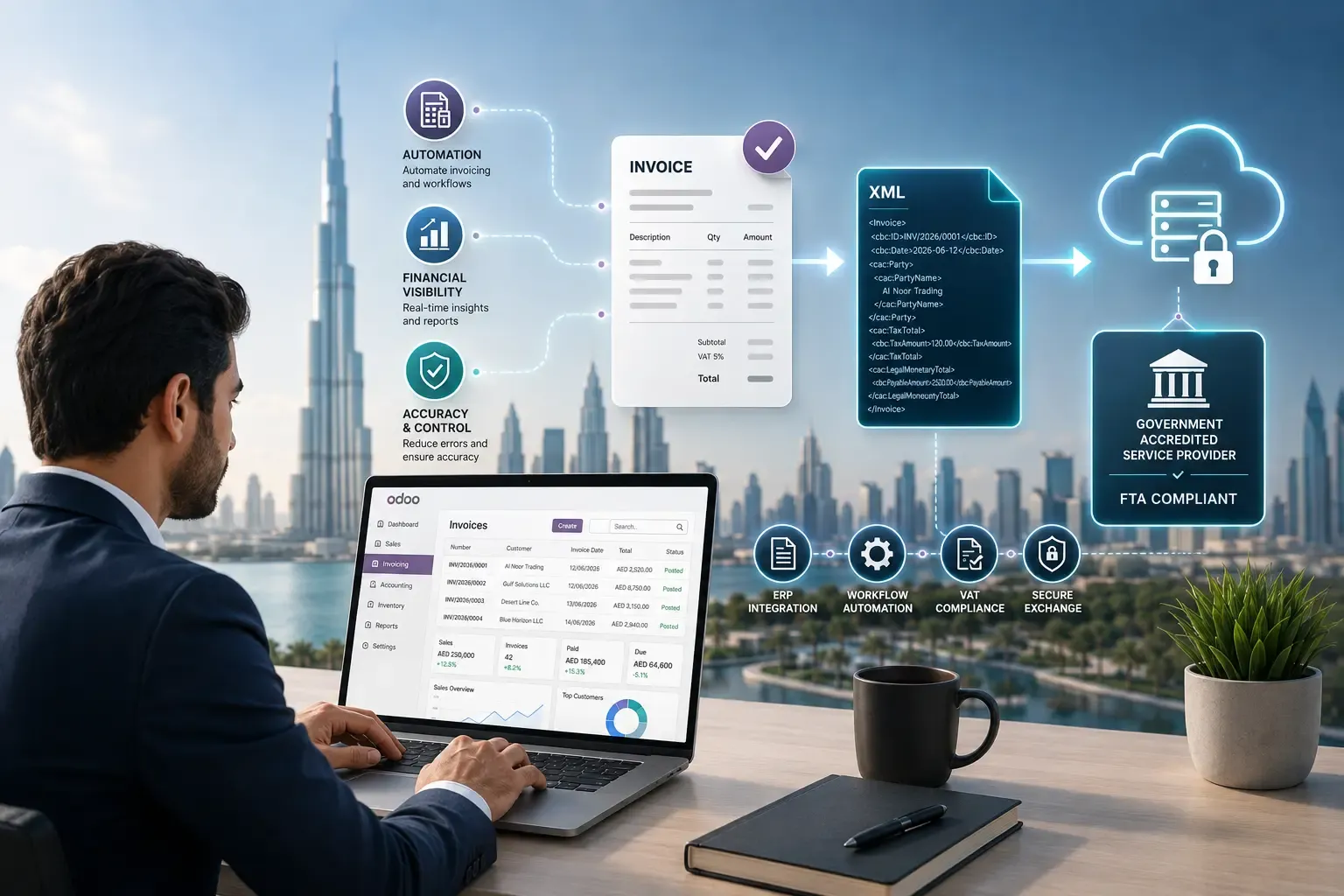
Yes — Odoo can support UAE e-invoicing, but the software alone doesn't make a business compliant. Odoo's UAE localisation handles VAT-ready accounting and structured invoices; full FTA compliance also requires connecting to a government-accredited service provider. Get both pieces right, and it becomes a real automation win, not just a checkbox.
If you're a business owner reading this because your accountant just mentioned "einvoicing" for the third time this month, you're not alone. Most of the UAE SMEs we work with come to us with the same question, worded slightly differently every time: "Do I really need to change how I invoice, and can my current system handle it?"
Let's walk through this properly, the way we would if you were sitting across the table from us.
What Is UAE E-Invoicing and Why Does Your Business Need It?
E-invoicing, in plain terms, is a structured digital invoice — not a PDF you email and hope gets filed correctly on the other end. Under the UAE's framework, an e-invoice has to be issued in a specific structured format (the FTA's data standard is called PINT AE, built on the international UBL/XML format), and it has to pass through a government-accredited service provider before it reaches your customer and the tax authority. A scanned or emailed PDF, however tidy, will not count as a valid e-invoice once the mandate applies to your business. The rollout is happening in phases: a voluntary pilot period opened in mid-2026, with mandatory go-live dates applying progressively by business category through 2027. Where your business sits on that timeline is worth confirming directly with the FTA rather than assuming — the exact phase depends on factors like turnover and sector. For a business owner, the practical difference is this: instead of manually typing invoice data into spreadsheets or accounting software, the invoice is created once, in the right format, and flows automatically into your books, your tax filings, and your customer's system. Fewer manual entries means fewer places for a number to get typed wrong.
Businesses need this shift for three reasons that matter beyond compliance:
- Accuracy.Manual invoicing is where most bookkeeping errors originate — a transposed digit, a missed VAT line, an invoice that never made it into the ledger.
- Speed. Structured invoices move through approval and payment cycles faster because there's less back-and-forth clarifying what was actually billed.
- Audit readiness.When the FTA asks for records, "we'll pull it together" is a worse answer than "here it is, already formatted."
Can Odoo Be Used for E-Invoicing in the UAE?
Here's the part worth being precise about, because a lot of what's written online blurs it: Odoo is not itself an FTA-accredited e-invoicing system, and no ERP — Odoo, SAP, Zoho, QuickBooks — becomes "FTA compliant" simply by being installed. Compliance under the UAE mandate is a two-part chain: your accounting system, and a government-accredited service provider (ASP) that connects it to the FTA's network and handles the actual invoice exchange.
What Odoo brings to that chain is a genuinely solid foundation. Its UAE fiscal localisation package gives you a VAT-ready chart of accounts, bilingual Arabic-English invoicing, and structured invoice data that's straightforward to map to the required format. What it doesn't do on its own is transmit invoices to the FTA — that connection has to run through an accredited service provider, which every business will need to appoint regardless of which accounting software they use. So the honest answer to "can Odoo do this" is: Odoo can carry the accounting and invoicing side well, and it needs to be paired with a properly configured ASP integration to close the compliance loop. Anyone telling you Odoo is compliant out of the box, without mentioningthe ASP requirement, is leaving out a step that will matter the first time your invoices actually need to reach the government.
How Does Odoo Solve Common E-Invoicing Challenges for UAE Businesses?
We see the same five problems on repeat when we sit down with a new client's books. Manual invoice errors. A retail client we onboarded was raising invoices in three different formats depending on which staff member created them. Odoo standardises this — one template, one numbering sequence, one set of tax rules applied automatically. Time-consuming accounting processes. When invoicing, VAT calculation, and ledger entry are three separate manual steps, month-end closing drags. In Odoo, they're one workflow — an invoice posted automatically updates the relevant accounts. Tax compliance challenges. VAT rates, exemptions, and reverse-charge scenarios are easy to get wrong by hand. Odoo's tax engine applies the correct treatment based on how you've configured product and customer categories, which removes a lot of the guesswork from a bookkeeper's plate. Lack of financial visibility. Business owners often don't know their real cash position until the accountant sends a report days later. With invoicing, payments, and accounting in one system, that picture is live instead of retrospective. Multiple system issues. Many UAE SMEs run invoicing in one tool, inventory in another, and accounting in a third — then spend hours reconciling them. Odoo's modules share one database, so a sales order, an invoice, and a stock movement are all the same record viewed from different angles.
Key Odoo Features That Help Businesses Manage E-Invoicing
- Automated invoice creation — invoices generate directly from sales orders or delivery confirmations, with tax and formatting applied automatically.
- Accounting integration — every invoice posts straight to the general ledger; no double entry.
- Tax management — UAE VAT rates and rules are configured at the product or customer level, so the right tax applies without someone checking manually each time.
- Reporting — real-time VAT reports, aging summaries, and profit-and-loss statements pull from live invoice data.
- Customer and vendor management — invoicing history, payment terms, and outstanding balances are tied to each contact record.
- ERP integration — invoicing sits inside the same system as inventory, sales, and purchasing, so nothing needs re-entering across tools.
Odoo vs Traditional Invoicing Methods: What Is Better for UAE Businesses?
| Factor | Traditional Invoicing (Manual/Excel) | Odoo E-Invoicing |
|---|---|---|
| Error rate | Higher — manual data entry | Lower — automated tax and numbering |
| VAT compliance | Depends entirely on staff accuracy | Built into the tax engine |
| Time per invoice | Several minutes, plus reconciliation later | Seconds, with automatic ledger posting |
| Audit readiness | Records scattered across files | Centralised, timestamped, searchable |
| Scalability | Breaks down as invoice volume grows | Handles volume without added manual work |
| Multi-system reconciliation | Manual matching between tools | One shared database |
For a business raising a handful of invoices a week, a spreadsheet might still feel manageable. Past that point — and especially once FTA e-invoicing requirements tighten — the manual approach becomes the more expensive option, just not in a way that shows up on a single month's bill.
How Sygmetiv Helps UAE Businesses Implement Odoo E-Invoicing Solutions
Software capability and a working implementation are two different things. We've seen businesses buy an Odoo licence, install the default setup, and end up more confused than before — because the chart of accounts wasn't mapped to UAE VAT categories, or invoice numbering didn't match what their auditor expected.
As a certified Odoo Silver Partner, our work sits in that gap between "the software can technically do this" and "this business's invoicing actually works correctly, every day, without someone fixing it manually." That includes UAE VAT and localisation configuration, migrating existing invoice and customer data without losing history, coordinating the ASP connection so invoices actually reach the FTA, training your team so the system doesn't depend on one person who understands it, and staying available after go-live for the inevitable edge cases a first month throws up.
One example from our own client feedback: Jazeera Al Huda Trading has spoken publicly about how our team handled their Odoo ERP setup, describing a smooth implementation and a measurable improvement in how they manage day-to-day operations since going live. That's the standard we hold ourselves to on every Odoo project — UAE e-invoicing included.
Need Help Setting Up Odoo E-Invoicing in UAE?
If you're weighing whether to configure Odoo yourself, hand it to a generic IT contractor, or work with a partner who's done UAE-specific Odoo and ASP integrations before, that last option is usually the difference between a smooth rollout and months of avoidable rework.
Talk to Our Odoo Team — tell us where your business currently stands with invoicing, and we'll walk you through what an FTA-ready Odoo setup looks like for your specific case.
Steps to Implement Odoo E-Invoicing in Your UAE Business
- Assess your current invoicing setup — what system you use now, invoice volume, and where VAT errors tend to happen.
- Choose the right Odoo edition and modules — accounting, invoicing, and any inventory or sales modules your business actually needs (not every module is necessary for every business).
- Configure UAE localisation— VAT rates, chart of accounts, invoice numbering, and bilingual formatting where required.
- Migrate existing data — customer records, past invoices, and outstanding balances, without losing audit history.
- Test with real transactions — run a parallel period alongside your existing system before switching over fully.
- Train your team — so invoicing doesn't depend on one person who understands the configuration.
- Go live and monitor — with support available for the first billing cycles, when most configuration gaps surface.
Is E-Invoicing Mandatory for My UAE Business?
The UAE's e-invoicing mandate is being phased in as part of the country's tax digitisation programme, with requirements applying progressively by business category and size — a voluntary pilot window opened in mid-2026, and mandatory dates follow through 2027. Whether it's currently mandatory for your specific business depends on your sector, revenue, and the FTA's rollout timeline. The FTA's official e-invoicing page is the authoritative source for checking where your business currently stands — this is worth confirming directly rather than assuming, since requirements are still rolling out for different business segments.
How to Transition to E-Invoicing Without Disrupting Operations
The businesses that struggle with this transition are almost always the ones that switch everything over in one weekend. A staged approach works better: configure the new system, run it in parallel with your existing invoicing for a few weeks, compare outputs, fix mismatches while the old system is still your safety net, and only then cut over fully. It takeslonger upfront. It also means you're not troubleshooting a broken invoicing system while trying to run your business.
Which E-Invoicing Solutions Are FTA Compliant?
FTA compliance isn't really a property of the software brand — it's a property of the configuration plus the accredited service provider connection used for data exchange. No accounting platform is "pre-certified" on its own; compliance comes from the ERP being correctly localised and paired with an FTA-accredited ASP. When evaluating any einvoicing solution, ask specifically: does it support UAE VAT categorisation correctly, can it produce invoices in the required structured format, and does the implementation partner have documented experience with both UAE tax localisation and ASP integration — not just general ERP experience. Odoo's official UAE fiscal localisation documentation covers the technical localisation features; how they're applied to your business, and how they connect to an ASP, is what determines whether you're actually compliant.