How Kerala Businesses Are Growing Smarter with Odoo
By Sygmetiv Odoo Team
Running a business is easy when you've only got a handful of customers, a few products, and a small team you can talk to in one WhatsApp group.
Then the business grows — and everything that used to work stops working.
Suddenly there are hundreds of customer enquiries a month, a couple of new branches, thousands of SKUs to track, several suppliers to juggle, online orders coming in alongside walk-ins, and a growing pile of invoices, payslips, and payments. If every department is still running on its own spreadsheet or notebook, even a simple question like “How many units do we actually have in stock?” can take an entire afternoon to answer.
This is exactly the gap that an ERP like Odoo is built to close.
What Actually Makes Odoo Useful?
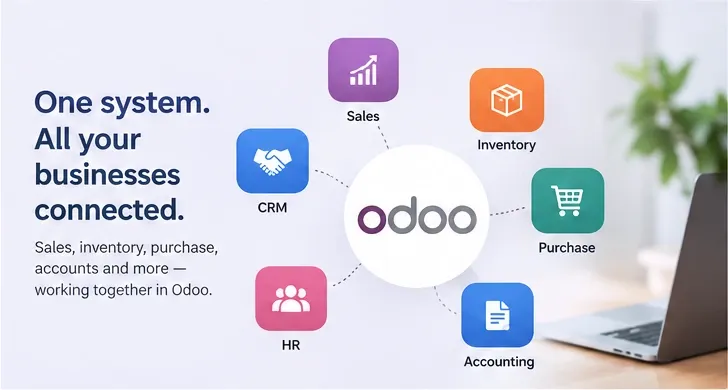 Picture Odoo less as “software” and more as a shared table where every part of your business sits down together.
Your sales team manages leads and quotations. Your warehouse team checks stock levels in real time. Your purchase team tracks suppliers. Your accounts team handles invoices and payments. None of this is new — every business does these things. What's different is that in Odoo, they're connected.
So when a customer places an order, your sales team doesn't need to manually message the warehouse, who then manually updates a stock register, who then manually informs accounts to raise an invoice. Once it's configured, that information simply moves through the system on its own. Less relaying information between people, less room for something to fall through the cracks.
Is Odoo Suitable for E-commerce Businesses?
Yes — and it's one of the more common reasons Kerala businesses start looking at Odoo in the first place.
Say you're running an online store with 500 products. A customer places an order. Now you need to know instantly whether it's in stock, get it packed and shipped, update the inventory count, and record the payment — all correctly, and all at once. Handle each of those steps in a separate tool, and sooner or later something breaks: you oversell a product that's already gone, or an order sits unshipped because nobody flagged it.
With Odoo, e-commerce and back-office operations run off the same data. You get a clearer, more honest picture of what's actually happening with your orders and your stock — instead of finding out after the fact.
Can Odoo Work With the Systems You Already Use?
This is usually the first question a business asks once Odoo starts to sound appealing.
“We already have a website, a payment gateway, accounting software — do we have to rip all of that out?”
Not necessarily. Odoo can connect with the tools you're already using — your website, payment system, shipping partner, or CRM — through built-in integrations, APIs, or custom development, depending on what you need. The goal here isn't to pile on more software for the sake of it. It's to get the systems you already rely on talking to each other properly, instead of operating as isolated islands.
Which Kerala Industries Can Actually Use Odoo?
Because Odoo is built in modules, it adapts to very different kinds of businesses rather than forcing them into one mould.
- Retail businesses typically lean on Point of Sale, Inventory, Purchase, Sales, and Accounting.
- Manufacturing companies need Manufacturing, Inventory, Purchase, Quality, Maintenance, and Planning working together.
- Service businesses are usually built around CRM, Sales, Projects, Timesheets, and Invoicing.
- E-commerce businesses combine Website, E-commerce, Sales, Inventory, CRM, and Accounting.
A textile retailer in Kochi and a manufacturing unit in Thrissur have almost nothing in common operationally — and yet both can run on Odoo, just configured completely differently.
Does Odoo Handle Multiple Currencies?
Yes. And for Kerala, this matters more than it might in other states — think of how many businesses here have customers in the UAE, suppliers overseas, and buyers back home in India, all at once.
Handling that isn't just about converting AED to INR on a calculator. It's about keeping organized, accurate financial records across all of it, without your books turning into a puzzle at month-end. Odoo's multi-currency features are built to manage exactly this kind of cross-border complexity within one system.
Is Odoo Good for Inventory Management?
For any business dealing in physical products, this is often where Odoo makes the most visible difference.
Take a distributor running three warehouses. If stock data lives in separate spreadsheets for each location, the sales team genuinely doesn't know what's available at any given moment — and it's not their fault. They might promise a customer a product that quietly ran out two days ago.
Did you know? This exact scenario — promising stock that isn't there — is one of the most common reasons businesses lose repeat customers, because it looks like unreliability even when it's really just a visibility problem.
Odoo brings products, warehouses, stock movements, purchases, and sales into one connected view, so teams can make purchasing and selling decisions based on what's actually true — not what a spreadsheet said three days ago.
Can Odoo Help With CRM and Sales?
Yes — and if your sales process currently lives across notebooks, email threads, and old WhatsApp chats, this alone can be transformative.
Odoo CRM lets a lead move through clear stages:
**New Lead → Contacted → Qualified → Quotation → Negotiation → Won **
At a glance, your sales team can see who needs a follow-up call today and who's still waiting on a quotation from last week. For a business fielding a high volume of enquiries, that visibility alone can be the difference between closing a deal and losing it to a competitor who called back first.
What About Businesses With Multiple Branches?
Say you're running a retail chain with outlets in Kochi, Thrissur, and Kozhikode. Management wants the big-picture view — overall revenue, overall stock — while each branch still needs to manage its own day-to-day sales and inventory.
Odoo can support exactly this kind of multi-branch structure, keeping local teams operating independently while feeding everything back into one connected picture for leadership. As a business expands to new locations, this becomes less of a nice-to-have and more of a necessity.
What Reports Can You Actually Generate in Odoo?
An ERP earns its keep not just by storing data, but by turning that data into something you can act on.
Odoo's reporting spans sales, purchases, inventory, accounting, CRM, and more — giving a business owner a real read on sales trends, stock levels, purchasing patterns, and financial health, without waiting for five different teams to each prepare their own spreadsheet by Friday evening.
Is Odoo Better for Manufacturing or Retail?
Honestly, that's the wrong question.
A manufacturer might use Odoo to manage raw materials, bills of materials, manufacturing orders, work centres, and quality checks. A retailer might lean almost entirely on Point of Sale, Inventory, Sales, and Accounting. Neither is “more” Odoo than the other. Quick comparison
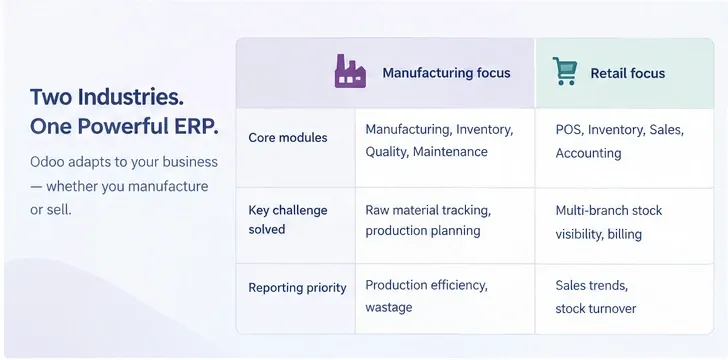
The real question isn't whether Odoo suits manufacturing or retail — **it's which modules match the way your specific business actually works. **
#Choosing the Right Odoo Implementation Partner
At this point, most businesses move on from “is Odoo right for us?” to a more practical question:
“Odoo looks like a good fit — but who's actually going to set this up for us?”
This is worth pausing on, because choosing an Odoo partner isn't the same as buying software off a shelf.
Your business already runs a certain way. You've got existing customer records, product catalogues, supplier relationships, accounting history, maybe a website and a payment gateway already in place. A good implementation doesn't ignore any of that — it starts by understanding it.
A checklist for what a proper implementation should cover:
- Business process analysis
- Odoo module selection
- System configuration
- Data migration
- Third-party integrations
- Custom development where required
- User training
- Testing
- Deployment
- Post-implementation support
The goal should always be to make Odoo fit around how your business actually operates — not to force your team to abandon everything that already works just because a new system arrived.
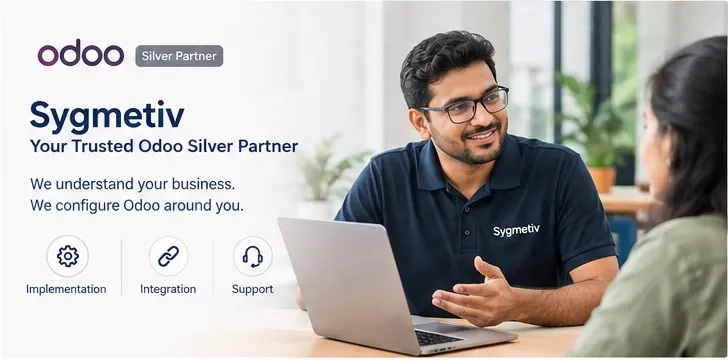
Sygmetiv — Odoo Silver Partner
For Kerala and India-based businesses looking for a partner to handle this properly, Sygmetiv is an Odoo Silver Partner, offering Odoo implementation and related business solutions.
Sygmetiv works with businesses to understand their operations first — whether that's CRM, sales, inventory, accounting, e-commerce, manufacturing, HR, multi-branch operations, or integrations — and builds the implementation plan around what the business actually needs, not a generic template.
Because at the end of the day, implementing Odoo isn't just installing software. It's understanding how your sales team actually sells, how stock actually moves through your warehouse, how your accounts are actually kept, and where information is currently slipping through the cracks. That understanding is what turns an ERP into something your team genuinely uses — instead of something they quietly work around.
Can Odoo Help Your Business Grow?
There's no single “correct” Odoo setup — because there's no single type of Kerala business.
A small retailer might start with just Sales, Inventory, Accounting, and POS. An e-commerce company might need Website, E-commerce, CRM, Sales, Inventory, and Accounting all working together from day one. A manufacturer might prioritize Manufacturing, Purchase, Inventory, and Quality. A service business might live almost entirely in CRM, Sales, Projects, and Invoicing.
The right starting point is never “which modules should we buy.” It's understanding your own process first — where exactly time and information are getting lost — and then building the Odoo setup around solving that.
If you're considering Odoo for your business, don't start with the module list. Start by mapping where your current process breaks down — then plan the implementation around fixing it.